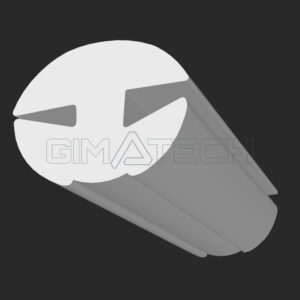


Technopolymers are high-performance plastic materials developed for technical and industrial applications where “common” plastics would not be sufficient. Compared to traditional polymers, technopolymers offer better mechanical, thermal, and chemical properties, greater dimensional stability, and often long-term durability.
- TPE (Thermoplastic Elastomers): It is a polymeric material that combines the properties of rubber (elasticity) with those of thermoplastics. Its behavior is similar to that of elastic rubber, but it can be melted and molded, allowing manufacturing processes such as injection molding, extrusion, or blow molding. It has good thermal resistance, chemical resistance, and excellent surface energy.
- PU (Polyurethanes): It is a versatile polymer formulated in various forms: rigid, semi-rigid, flexible, or foam. In the context of seals and technical components, an elastic PU is mainly used. It has good chemical and temperature resistance, good compression set, and excellent surface energy.
- PVC (Polyvinyl Chloride): It is a widely used thermoplastic polymer thanks to its versatility, low cost, and ease of processing. It can be rigid or flexible. It offers good chemical resistance against water, diluted acids, bases, and many household chemicals. It has good surface energy, which can be increased through surface treatments, and fair temperature resistance.
Differences between TPE and EPDM:
Why consider TPE as an alternative to EPDM?
TPE represents a modern and efficient solution compared to traditional EPDM, especially when the goal is process optimization and flexibility in production. Unlike EPDM, TPE allows for faster production cycles, greater dimensional repeatability, and easier scrap management, offering clear advantages in terms of industrial efficiency and sustainability.
From a design perspective, TPE provides greater design freedom: it can be easily molded with rigid materials, colored, and integrated into complex components without secondary operations. This helps reduce the number of parts, simplify assembly, and lower the overall cost of the finished product.
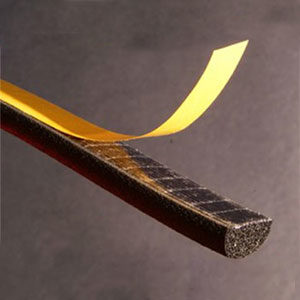
An additional, often underestimated advantage is better adhesion compared to EPDM. Many TPEs, especially those based on polar materials, have more favorable surface energy, making the use of double-sided adhesives more reliable and often eliminating the need for primers or surface treatments.
Differences between TPE and EPDM in terms of sustainability
EPDM is a vulcanized rubber characterized by exceptional resistance to weathering, UV rays, ozone, and high temperatures. This long durability makes it ideal for outdoor applications or those exposed to harsh conditions, reducing the need for frequent replacement.
However, since it is vulcanized, it cannot be melted or remolded after use, making recycling practically impossible. At the end of its life, EPDM seals typically end up in landfills or are incinerated, resulting in a significant environmental impact.
TPE, on the other hand, is a thermoplastic polymer that combines the elasticity of rubber with the processability of plastic. Although it generally has slightly lower resistance to UV rays, ozone, and high temperatures compared to EPDM, it has a crucial advantage in terms of sustainability: it can be melted and remolded without losing its main properties. This makes recycling feasible and helps reduce plastic waste. Production scraps can be reused in molding or extrusion processes without altering their elastomeric properties. It can also be recovered and transformed into new components, often with a small percentage of virgin material, and generates fewer toxic residues during disposal.
Which one to choose?
EPDM excels in durability and resistance but has environmental limitations related to end-of-life and recycling. TPE, while slightly less durable under extreme conditions, offers greater recyclability and a lower production impact, making it more sustainable within a circular economy perspective.