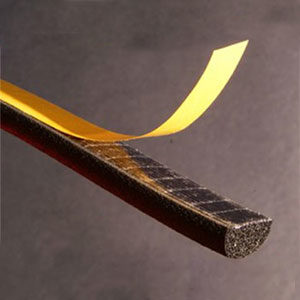


Double-sided adhesives are tapes coated with adhesive on both sides, designed to quickly, cleanly, and durably bond two surfaces without the need for screws, nails, or liquid glues. Commonly used in industrial applications, they provide a practical solution for invisible joints, precise assemblies, and applications that require reliability and simplicity. Thanks to the various types available, double-sided tapes can adapt to multiple materials and conditions of use, ensuring durable and professional results.
What are the types of double-sided adhesives based on the adhesive type?
- Acrylic (includes acrylic foams): Medium tack, high temperature resistance, resistant to UV rays and chemical agents.
- Modified acrylic: Medium tack, high temperature resistance, resistant to UV rays and chemical agents.
- Rubber-based: High tack, lower temperature resistance, lower resistance to UV rays and chemical agents.
- Polyurethane foams: Medium tack, high temperature resistance, resistant to UV rays and chemical agents.
What are the structures of double-sided adhesives?
- Supported: A supported double-sided tape features a carrier layer that provides stability and thickness to the adhesive, easier handling, improved mechanical strength, and better insulation, vibration compensation, and absorption (examples of supports: plastic film, fabric or nonwoven fabric, foam).
- Transfer: A transfer double-sided tape has no carrier and consists only of an adhesive layer supplied on a siliconized liner. It offers extremely low thickness, high adhesion, and good conformability to irregular surfaces.
- Mesh reinforced: A mesh-reinforced double-sided tape includes a mesh embedded within the adhesive layer. It can be supported or unsupported and generally provides high tensile strength (non-extensibility), long-term stability, strong hold on irregular surfaces, and good resistance to temperature and humidity.
Main application sectors
- Automotive
- Electronics
- Construction
- Industry
What are the physical principles of double-sided adhesive performance?
- Wettability: Wettability refers to the ability of the adhesive to penetrate and follow the micro-irregularities of the surface, ensuring adhesion. It depends on several factors:
- Surface energy of the material
- Adhesive composition and viscosity
- Application pressure
- Surface cleanliness (dust, grease, or moisture reduce or eliminate adhesion)
- Surface treatments
- Priming
- Time effect: Double-sided adhesives increase their bond strength over time as the adhesive continues to “flow,” enhancing molecular contact. Maximum adhesion is typically achieved after 48–72 hours.
What is meant by the surface energy of a material?
Surface energy is the energy associated with the atoms or molecules on a material’s surface. The higher the surface energy (high wettability), the better the contact with the adhesive.
If this condition is not met, contact with the adhesive will be poor, resulting in weak adhesion.
Each material type has its own reference surface energy, but several factors can negatively affect it:
- Surfaces contaminated with oils, dust, or moisture
- Nature of the surface
How can surface energy be improved?
In today’s industrial processes, surface treatments such as plasma treatment, corona treatment, and chemical primer treatment are commonly used.
These technologies increase surface energy, improving the interaction between surface and adhesive.
Materials with high and low surface energy
Low surface energy: PE, PP, PTFE, silicone, silicone rubber, fluorinated elastomers, painted surfaces or those treated with release agents, and plastics with oily or waxy surface additives.
Medium surface energy: Natural rubbers (NR), polar synthetic rubbers (NBR-CR-EPDM).
High surface energy: Metals, glass, polar plastics, paper, and PVC.
Application temperatures
The application temperature of double-sided tapes defines the temperature range within which the adhesive can be properly applied, ensuring good initial tack.
- Acrylic double-sided: 15°C
- Rubber-based double-sided: 15°C
- Transfer double-sided: 15°C
- Supported double-sided: 15°C
Applying the adhesive outside the correct temperature range can lead to poor bonding, early detachment, and long-term failure.
Surface cleaning before adhesive application
“The adhesive sticks to the first thing it encounters.”
The surface must be clean, free from oils, dust, grease, and waxes, ensuring a dry and compatible surface.
Even the best adhesive will fail if applied to a contaminated surface.